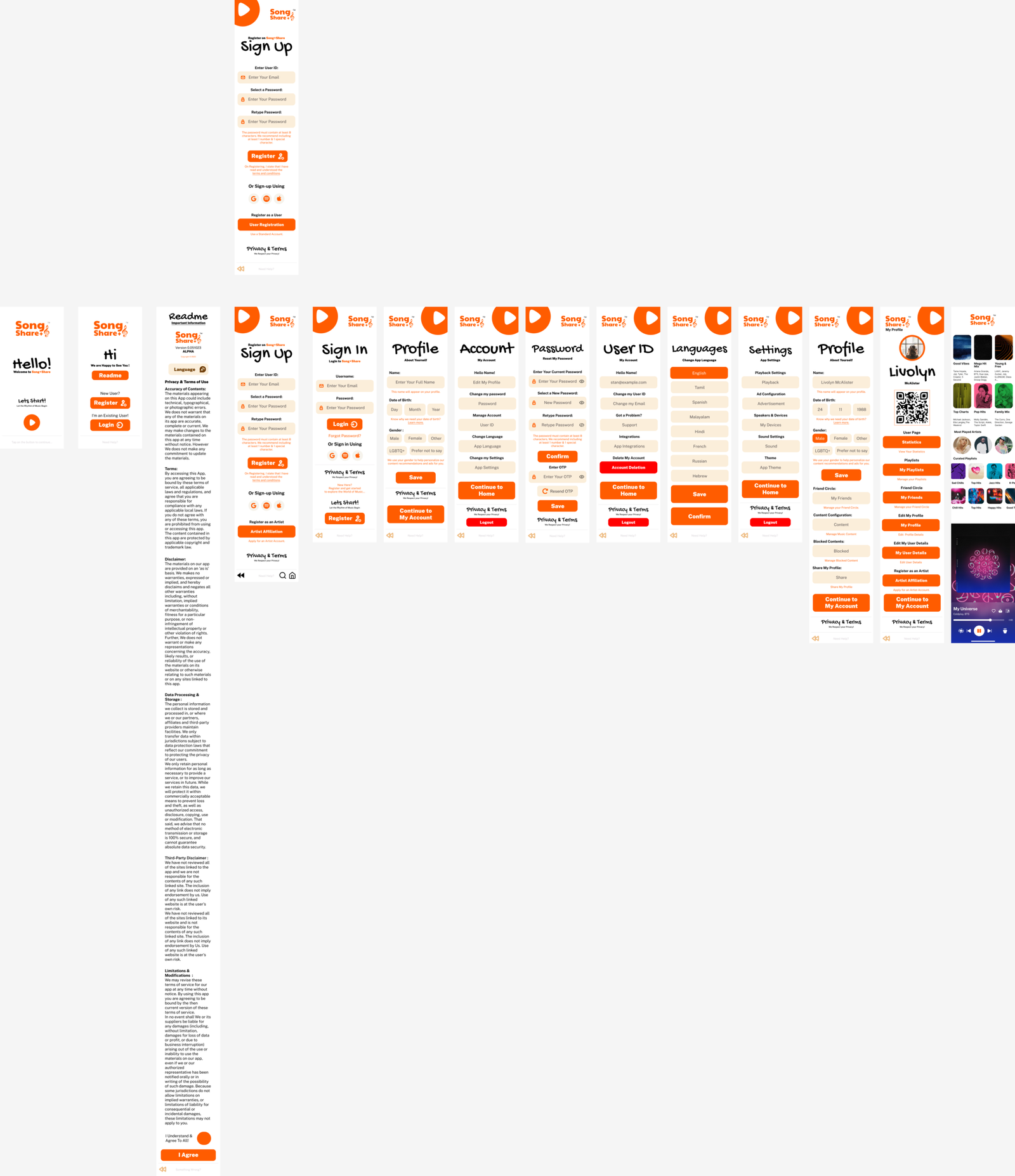
Project for Google Certificate Course
Project Music Share
UXS-PMS-2022
- Stalin Sunny -
Important Notice:
Non-Disclosure Agreement (NDA):
This Web Content is intended to protect the confidentiality of proprietary and sensitive information shared between parties. By viewing this agreement, the receiving party agrees not to disclose, share, or use any information without prior written consent from the disclosing party. This includes, but is not limited to, intellectual property, trade secrets, designs, software, business strategies, and other confidential materials.
Copyright Statement:
All content, designs, and materials provided are protected by copyright laws and remain the intellectual property of their respective owners. No portion of this work may be reproduced, distributed, or transmitted in any form or by any means, including photocopying, recording, or other electronic or mechanical methods, without prior written permission from the copyright holder.
Introduction
"Design a music sharing app for a musician."
Music is one of the most powerful creation in the World. Everyone loves some kind of Music. The Amazing People behind the creation of Music works hard to make tremendous compositions and rhythms. The world of social media provides them the opportunities to connect and collaborate with their followers. But sometimes it gets hard for a Musician to reach out the audience organically. They must further promote their music in order to reach the public. This seems hard for upcoming musicians, So it is necessary to build a music sharing app where apart from all distractions one can concentrate on only Music. They can easily connect with a fan. They can also be used for connecting various streaming apps for convenience. I love music and amazing people who compose them. So, I like to create something beautiful for the world of music.
Primary Research goals:
Goal 1: Identify Common Behaviors and Experiences
Artists: How they distribute music, engage with fans, and use sharing to build visibility.
Fans: How they currently discover, consume, and share music; what sharing looks like in daily life.
Goal 2: Understand Needs and Frustrations
Artists: Challenges in reaching audiences (discoverability, monetization, lack of control over distribution).
Fans: Barriers to seamless sharing (platform boundaries, exclusivity, algorithm bias, regional restrictions).
Goal 3: Explore the Current State of Music Sharing
Artists: How the system influences career growth, exposure, and cultural relevance.
Fans: How the system shapes identity, community, and emotional connection.
Target Interview Topics:
1. Access & Availability
2. Community & Interaction
3. Discovery & Algorithms
4. Usability Design & Emotional Impact
5. Limitations & Frustrations
Questions for Artists:
Q1. How do you make your music available across different platforms?
Q1b. What impact did that have?
Q1a. Have you faced issues with distribution or regional restrictions?
Q2. How do you engage with fans when they share your music?
Q2a. Can you recall a time when fan sharing boosted your visibility or career?
Q3. How do algorithms affect the visibility of your work?
Q3a. Do you think you have a delay for the music to reach all your active followers?
Q3b. Do you feel the system favors mainstream artists?
Q3c. How do you navigate that?
Q4. How does platform design influence how you present your music to fans?
Q4a. Do current systems allow you to express the emotional or cultural context of your work effectively?
Q4b. Do you see music sharing as more of a global opportunity or a way to strengthen local fan bases?
Q5. What are the biggest obstacles you face when trying to get your music shared widely?
Q5a. How do these limitations affect your relationship with fans or your ability to grow your audience?
Questions for Fans:
Q1. How easy is it for you to access and share music across different platforms?
Q1a. Can you share a moment when platform restrictions stopped you from sharing?
Q1b. How did that feel?
Q2. How do you connect with other fans through music sharing?
Q2a. Do these interactions feel like building community, or are they more casual exchanges?
Q3. Do recommendation systems help you discover music you genuinely enjoy?
Q3a. How do algorithmic suggestions compare to recommendations from friends or communities?
Q4. How does platform design affect your ability to share music easily?
Q4a. Do you feel the system captures the emotional side of sharing music, or is it mostly functional?
Q4b. How does sharing music influence your identity or sense of belonging?
Q4c. Do you feel music sharing today connects people globally, or is it still rooted in local scenes?
Q5. What frustrates you most about sharing music today?
Q5a. If you could change one thing about the current system, what would it be?
Target participant characteristics:
Creators
Emerging artists: Those building visibility and growth primarily through sharing.
Independent or DIY creators: Musicians distributing directly without label support, showing grassroots practices.
Regional artists: Artists working in local languages or scenes, highlighting cultural reach and community identity.
Listeners
Active sharers: Fans who frequently share playlists, links, or recommendations.
Community‑driven fans: Those engaged in online groups or fan clubs where sharing builds collective identity.
Global and local fans: To capture differences between international exposure and loyalty to local scenes.
Responses by Artists:
Response by Emerging Artist DJ Loom
Age: 20-25
Electronic Music Producer
Q. How do you make your music available across different platforms?
I use a digital distributor (like DistroKid) to push my WAV files to Spotify and Apple Music. I set a 4-week lead time to pitch to playlists and use verified artist profiles to keep my minimalist aesthetic consistent across every screen.
Q. Have you faced issues with distribution or regional restrictions?
I’ve faced issues with low payouts in India compared to the US. It makes it tough to afford the high-end hardware I need for production. Plus, some global distributors are slow to update on local apps like JioSaavn, which kills the momentum of a release.
Q. What impact did that have?
The real impact is that it holds back the production. When the money from streams is basically non-existent, it’s hard to justify the cost of new equipment or high-end monitors. It keeps the emerging phase feeling like a grind because I have to spend time on other work just to fund the studio time. It basically slows down my output and forces me to be way more selective about what I actually release.
Q. How do you engage with fans when they share your music?
When fans share my music, I keep it direct and personal. I usually message them to ask which specific sound or rhythm caught their ear. I also post the raw field recordings or the structural sketches of the track on my stories. It helps them understand the architecture of the sound rather than just hearing the final product. It builds a real connection instead of just a generic thank you.
Q. Can you recall a time when fan sharing boosted your visibility or career?
When fans share my music, I keep it direct and personal. I usually message them to ask which specific sound or rhythm caught their ear. I also post the raw field recordings or the structural sketches of the track on my stories. It helps them understand the architecture of the sound rather than just hearing the final product. It builds a real connection instead of just a generic thank you.
Q. How do algorithms affect the visibility of your work?
The algorithm is basically a mystery to me. All I really know is that if people don't save the track or if they skip it too fast, it feels like the song just disappears. I can see the numbers flatline on my dashboard and it is frustrating because I do not always know what I did wrong. It feels like I have to beg friends to listen just to get the system to show my music to one or two strangers.
Q. Do you think you have a delay for the music to reach all your active followers?
The delay is real and very frustrating. Even if someone follows me, the apps don't show them my new music immediately. My followers usually won't see a track in their Release Radar until days later. On social media, only a small fraction of my fans actually see my posts about a new drop. I end up having to message people manually just to make sure they know the music is out.
Q. Do you feel the system favors mainstream artists?
I honestly don't understand how the technical side of it works. All I see is that the big artists are everywhere and my music stays hidden in a corner. It feels like the apps are built for people who are already famous. When a superstar drops a song it shows up on everyone's front page instantly but I have to beg people to even find my link. It is like trying to win a race where the other person started a mile ahead of me.
Q. How do you navigate that?
I just try to bypass the systems I don't understand. I send my music directly to people or post clips of how I make the sounds on social media. I figure if I can get enough individuals to care, the platforms will eventually have to catch up. It is a lot of manual work and messaging, but it feels more reliable than just hoping a computer picks me up.
Q. How does platform design influence how you present your music to fans?
The design of the apps makes me focus on the first few seconds of a track. I have to find a quick hook or a cool visual just to keep people from scrolling. It feels like I am managing a storefront where I have to constantly ask people to save the song or use the audio just to stay visible. I spend more time worrying about the presentation than the actual music.
Q. Do current systems allow you to express the emotional or cultural context of your work effectively?
The apps do a poor job with that. They treat my music like background noise for studying or working out, which ignores the deeper story. There is no space on the platform to explain my culture or the meaning behind a sound. I have to use my own social media to tell the real story because the streaming apps just see my art as a generic file in a library.
Q. Do you see music sharing as more of a global opportunity or a way to strengthen local fan bases?
I see it as both, but I focus on my local base. The internet makes global reach possible, but people nearby actually understand the cultural sounds and stories I'm sharing. A local foundation feels more real and supportive, whereas being global often just means being a random file in a massive database.
Q. What are the biggest obstacles you face when trying to get your music shared widely?
The biggest hurdles are the lack of budget and the noise. Without money for professional marketing or boosted posts, my music is competing against stars who have massive teams.There is also so much content being uploaded every second that it’s easy for a new track to get buried instantly. Since I don't understand the technical side, it feels like I'm shouting into a void and hoping someone hears me before the next person starts shouting louder.
Q. How do these limitations affect your relationship with fans or your ability to grow your audience?
The limitations force me to prioritize speed over depth. To stop people from scrolling, I have to focus on instant hooks rather than emotional storytelling. I end up spending more time on admin and social media than on actual music, which makes my relationship with fans feel more like a transaction than a creative connection.
Response by Independent Artist Vane
Age: 24
Independant Musician
Q. How do you make your music available across different platforms?
I use digital aggregators like DistroKid or TuneCore. I upload my tracks to them, and they push the music out to Spotify, Apple Music, and everywhere else. I keep all my rights, pay a small fee, and they collect the royalties for me. It’s all automated, so I can stay independent.
Q. Have you faced issues with distribution or regional restrictions?
Yeah, I run into issues. Regional delays often mess up my release timing, making the music drop in some countries hours before others. I also hit licensing gaps where my distributor doesn't reach certain international platforms. Worst of all, the algorithm tends to keep me stuck in a local bubble, which makes it a struggle to grow a global audience without serious cash for ads.
Q. What impact did that have?
It killed my momentum. When the release is staggered, I can’t have one big global moment on socials, which confuses fans and weakens my stats. Missing out on specific regions means I lose potential revenue and fans I can't even reach. Being stuck in a local loop is the worst because it stunts my growth, making it feel like I’m shouting into a room that’s way too small for the sound I'm trying to build.
Q. How do you engage with fans when they share your music?
I jump on it immediately by sharing their posts to my stories and tagging them. It builds a real connection when I take the time to reply to every comment or DM instead of just leaving a generic like. I also keep a folder of fan-made clips to feature on my page, which turns listeners into a community. Making them feel like part of the journey is the only way to grow when you do not have a label pushing you.
Q. Can you recall a time when fan sharing boosted your visibility or career?
A few months back, a fan used a 15-second snippet of one of my tracks in a travel transition reel that actually went semi-viral. It wasn't a huge influencer, just someone who really vibed with the mood. Because they tagged me, my profile visits spiked and I saw a massive jump in Shazams and saves from people outside my usual circles. That one organic moment did more for my monthly listeners than any paid ad campaign I've ever run.
Q. How do algorithms affect the visibility of your work?
Algorithms are basically my boss. If they do not see high engagement in the first few hours, they bury the track and stop showing it to new people. I have to design everything around triggers like save rates and re-watches just to keep the system happy. It is a double edged sword because a lucky break can blow me up overnight, but most days it feels like I am fighting a machine that only cares about data and not the actual art.
Q. Do you think you have a delay for the music to reach all your active followers?
Yeah, it’s a major issue. On social media, the algorithm never hits all my followers at once. Only about 3 to 5 percent of them might even see a post in their feed initially. If they don't engage right away, the platform stops pushing it, meaning a huge chunk of my active community might not even know I dropped something for days. On the streaming side, the time zone rollout creates a literal delay. Since music usually drops at midnight local time, my fans in one part of the world are vibing to the track while others are still waiting for hours. It makes it impossible to have a single, unified hype moment on socials because half the audience can’t even listen yet.
Q. Do you feel the system favors mainstream artists?
The system is definitely rigged for the big players. Major labels have the cash to manipulate the algorithms and the connections to lock down the best playlist spots before an independent artist even gets a chance to pitch. Since the platforms prioritize high-volume traffic and massive marketing spends, the top 1% ends up hogging almost all the visibility and revenue. For someone like me, it means fighting for scraps in a machine designed to keep the rich at the top while independent creators are left to grind twice as hard for a fraction of the reach.
Q. How do you navigate that?
I bypass the machine by building my own ecosystem. I use direct platforms like Bandcamp or Discord to connect with fans without a middleman or algorithm blocking the way. By involving my community in the creative process, I turn listeners into a loyal team that supports me even when the mainstream ignores my work.
Q. How does platform design influence how you present your music to fans?
I strip everything down to the essentials to survive the feed. Because users swipe so fast, I focus on high-impact visuals and immediate hooks that work without sound to grab attention before they move on. The layout dictates that my cover art stays bold and simple so it remains readable as a tiny icon on a mobile screen. Every piece of music I release has to be packaged into a visual format that fits the interface, turning the art into a functional piece of digital content.
Q. Do current systems allow you to express the emotional or cultural context of your work effectively?
Not really. The current systems are built for broad consumption, which often strips away the nuance of why a song was written. On major streaming platforms, my work is reduced to a thumbnail and a title, leaving very little room to explain the cultural roots or the personal story behind a track. The algorithms prioritize mood and genre over meaning, so if a song doesn’t fit into a pre-defined chill or focus category, the system struggles to find a place for it, regardless of its emotional depth. To bridge that gap, I have to work twice as hard outside the platforms. I use features like Canvas or Storyline to add small visual cues, but true context usually happens on social media or through direct fan channels where I can actually talk about my heritage or the specific experiences that shaped the sound. It feels like I’m constantly fighting a design that treats music as background noise rather than a cultural statement.
Q. Do you see music sharing as more of a global opportunity or a way to strengthen local fan bases?
It is a balance, but local roots come first. A strong local base provides the cultural connection and authentic momentum needed to sustain a career. Once that foundation is solid, global sharing allows the music to reach niche audiences elsewhere. I view the local community as the heart and global reach as the lungs; one preserves my identity while the other helps the art grow.
Q. What are the biggest obstacles you face when trying to get your music shared widely?
The biggest hurdle is the sheer noise. Algorithms prioritize big budgets and instant viral metrics, making it nearly impossible to break through without a massive marketing spend. Because discovery is now reduced to 15-second clips, the emotional depth of my work often gets lost in favor of bite sized content. I am constantly forced to balance my creative vision with the high impact, minimalist packaging required just to be noticed in a crowded feed.
Q. How do these limitations affect your relationship with fans or your ability to grow your audience?
These barriers create a disconnect that forces me to be more intentional. Because algorithms gatekeep my reach, I can't rely on passive growth; I have to build direct, deeper lines of communication to ensure my most loyal followers actually see what I create. This shift makes audience growth slower and more manual, but it also filters for people who truly value the story behind the work rather than just a passing trend. Ultimately, it transforms the fan relationship from a simple follow into a more resilient community that exists outside the whims of a platform's design.
Response by Regional Artist Shreya
Age: 42
Folk singer and Songwriter
Q. How do you make your music available across different platforms?
I don't bother with the technical headache myself. I take my music down to the local media studio in the city, and they handle all those websites and apps for me. If I'm in a pinch, my cousin comes by with his laptop and clicks whatever buttons need clicking to get my music out there.
Q. Have you faced issues with distribution or regional restrictions?
It’s a headache, truly. Sometimes the folks in the studio tells me a song isn’t showing up in certain places because of some license or territory nonsense. I don't understand the jargon, but it’s frustrating when someone from our community living abroad says they can’t find a specific track. I just tell my cousin or the studio owner to fix it. I’ve lived long enough to know that if you push hard enough, there’s always a way around a closed door. My job is to write the songs that connect us, regardless of what some computer in another country thinks. I just want our language and our stories to be heard.
Q. What impact did that have?
It’s disheartening, really. When a song I’ve poured my soul into writing gets blocked by some invisible wall, it feels like our community is being silenced or split apart. It slows down the momentum of a new release, and I hate thinking that someone from our village who moved away is missing out on a piece of home. I just stay firm with the studio and my cousin until they find a way to clear the path, because our stories deserve to travel as far as our people do.
Q. How do you engage with fans when they share your music?
I leave all that screen-tapping to the younger ones. When people share my songs, my cousin is the one who sees it first on his phone and shows me the kind words they’ve written. If it's someone from our own soil or a familiar face, I might tell him what to type back, but usually, I just send my blessings through him. I’d much rather hear from them in person maybe after a match or while I'm out walking but it warms my heart to know my verses are traveling.
Q. Can you recall a time when fan sharing boosted your visibility or career?
It was a few years back when a group of women from a nearby village started sharing a song I’d written about the strength of our mothers. They weren't using any fancy equipment just their phones but they played it at every gathering and wedding until the melody was everywhere. My cousin showed me dozens of videos of people singing along to my verses, and suddenly the studio in the city was calling me because so many people were asking for the full recording file. It just goes to show that when a song speaks the truth of a woman's life, our sisters will make sure it’s heard. I didn't need a computer to tell me it was a success; I could hear it in the voices of the women whenever I walked through the market.
Q. How do algorithms affect the visibility of your work?
I don't waste time worrying about algorithms or whatever technology they use. My voice and pen belongs to the earth and the people. The studio tells me the computer prefers certain patterns, but as a folk singer and songwriter, I won't trim my melodies or change my verses to suit a machine's taste.I stay focused on the soul of the song. If a piece is honest and rooted in our soil, it will find its way to the people. No foreign tune or melody can force change me or my music.
Q. Do you think you have a delay for the music to reach all your active followers?
There’s definitely a delay, but it doesn’t trouble me like it does thefolks at the studio. They get all worked up talking about instantreleases and syncing, while I’m just sitting here with my tea. SometimesI’ll have a new song ready, but by the time the city studio clears thetechnical hurdles. It used to bother me, but now I see it differently.Real folk music isn't a race; it’s a conversation. If my followers haveto wait a few days for the digital version to catch up to my voice, sobe it. A good story doesn't sour if it sits for a moment. As long as thesong eventually reaches the people who are waiting for it, I don't mindthe slow road the computer takes. Truth be told, I still prefer the days when we handed someone a physical CD.
Q. Do you feel the system favors mainstream artists?
It certainly feels that way. The city studio says the system is built for loud, flashy tunes that vanish in a blink, favoring polish over the slow-burning soul of a folk melody. My cousin shows me how mainstream faces fill the front pages while our traditional verses are tucked away. But I don’t mind; those songs have the speed of the wind, but they lack the roots of an old tree. I’d rather have a few listeners who truly feel the earth in my voice than a million who forget the tune by sunset.
Q. How does platform design influence how you present your music to fans?
The studio is always nudging me to worry about visuals, as if the melody isn't enough. It feels like these platforms are designed for the eyes first and the ears second. The graphic designers in my village are helping me with cover design and all. I always prefer simple natural photos but they say proper art is needed to catch the eye.
Q. Do current systems allow you to express the emotional or cultural context of your work effectively?
To be honest, a digital screen is a cold place for a warm story, as these platforms are built for speed rather than the weight of history or the silence between notes. My cousin tries to bridge that gap by recording videos of me explaining the stories behind my verses to share on social media; he then looks at the people’s comments to figure out which tags will help the music travel further. It feels a bit like trying to bottle the wind, but I let him handle that digital side of things while I stay focused on the song itself. I still believe that if a melody is rooted deeply enough in our soil, the heart will hear what the software cannot.
Q. Do you see music sharing as more of a global opportunity or a way to strengthen local fan bases?
While the studio views these digital platforms as a vast global stage, I see them primarily as a way to nourish and strengthen our local roots. My family gets excited when the data shows listeners from distant cities tuning in, and it is a fine bonus that our village stories can travel across oceans, but my true joy comes from knowing these tools help our songs reach the younger generation right here at home. I’d rather use this technology to ensure a neighbor three houses down stays connected to our shared history than worry about being heard in a land I’ve never walked.
Q. What are the biggest obstacles you face when trying to get your music shared widely?
The main struggle is that the internet loves fast, flashy things, while my music is slow and quiet. The studio says the systems are built for trends, so my cousin has to work extra hard just to get our traditional songs to show up on people's screens. It is tough to be heard when the whole world is in a rush, but I won't change my sound just to please a machine.
Responses by Fans:
Response by Music Listener Lee
Age: 22
University Student
Q. How easy is it for you to access and share music across different platforms?
Accessing music is easy, but sharing it across different platforms is a massive headache. If I send a Spotify link to a friend who uses Apple Music or YouTube Music, it kills the vibe because they can't open it easily. I usually have to use link-sharing tools or just send a screenshot of the album art so they can search for it themselves, which takes all the fun out of sharing a great track.
Q. Can you share a moment when platform restrictions stopped you from sharing?
Last week, I found an amazing indie track on Spotify and texted it to my group chat, but the hype immediately died because half the guys used Apple Music. Instead of hearing the song, they got hit with log-in screens and errors, forcing me to take screenshots and type out the track name manually. That instant spark of sharing a new discovery completely evaporated just because the platforms refuse to talk to each other.
Q. How did that feel?
It completely killed the momentum and turned an exciting moment of discovery into an annoying tech support chore. Instead of talking about the vibe of the song, we spent ten minutes troubleshooting links and typing out text searches. It makes sharing music feel isolated and frustrating, because you realize you aren't just sharing a great melody but also you're forcing people into a platform ecosystem they don't belong to.
Q. How do you connect with other fans through music sharing?
I connect with other fans by treating playlists like digital mixtapes and starting specific music threads online. Instead of just dropping a random link, I love sharing tracks along with the exact vibe or aesthetic they match, such as songs that feel like walking through a rainy city at midnight. That usually triggers a chain reaction where others reply with their own hidden gems, creating a collaborative, back and forth energy that builds a real community around a shared taste.
Q. Do these interactions feel like building community, or are they more casual exchanges?
They start out as casual exchanges, but over time they definitely build a genuine community. A single track share might just be a quick, passing interaction, but when you consistently trade music with the same people, you start to understand their personal taste, their moods, and how they think. Eventually, you realize you have built a tight-knit circle of people who trust your ear and rely on each other for that next great musical discovery, which goes way deeper than just a casual comment online.
Q. Do recommendation systems help you discover music you genuinely enjoy?
Algorithms are great at serving up music that matches my established taste, but they only get me about halfway there. They are excellent at keeping a specific mood going, but they rarely deliver the unexpected magic of a true sonic breakthrough because they rely entirely on historical data. They keep me trapped inside a comfortable bubble, completely missing the human context and emotional shifts that only a friend or an enthusiastic blogger can tap into. The system handles the predictable background listening, but human curation is where the real soul of discovery lives.
Q. How do algorithmic suggestions compare to recommendations from friends or communities?
Algorithmic suggestions are highly efficient and analytical, pinpointing exact sonic patterns based on data, but they ultimately lack a soul. A machine can perfectly match a tempo or a genre baseline, but it keeps you confined within a safe, predictable loop. Recommendations from friends or communities, on the other hand, bring unpredictable human context and emotional weight. A friend knows what you are going through personally, and a community introduces you to cultural subtext and wild, erratic shifts in taste that data simply cannot predict. Algorithms manage the routine soundtrack of my day, but human connection is what actually redefines my taste.
Q. How does platform design affect your ability to share music easily?
Platform design acts as a digital wall because streaming services are built to trap users inside their own ecosystems rather than allow open sharing. Instead of using universal web standards, platforms use proprietary links that force non-users through friction-filled sign-up screens or broken web previews. This design layout completely prioritizes corporate user acquisition over user experience, turning a simple, generous social interaction into a frustrating tech barrier. By forcing everyone into a specific interface, the design stifles the organic, conversational flow of sharing a great discovery.
Q. Do you feel the system captures the emotional side of sharing music, or is it mostly functional?
It is almost entirely functional. The system treats music like utility data to feed an engagement loop, completely missing the vulnerability and excitement behind the swap. It builds the pipeline, but cannot capture the emotional weight of sharing a song that holds a shared memory or an unspoken mood.
Q. How does sharing music influence your identity or sense of belonging?
Sharing music is central to my identity because it acts as an extension of my personality and a bridge to find my people. Unearthing a rare track and passing it along feels like sharing a piece of my own taste and creative outlook. When someone truly connects with that track, it provides a deep sense of belonging, validating that we operate on the same emotional wavelength. It transforms music from a solitary, internal experience into a shared cultural language that defines who I am and cements my place within a community.
Q. Do you feel music sharing today connects people globally, or is it still rooted in local scenes?
It does both, but the global connection often lacks the depth of a local scene. Digitally, music sharing effortlessly crosses borders, allowing someone to connect instantly over a niche genre with a person thousands of miles away. However, this global reach is largely flat and digital. True local scenes are rooted in shared, physical experiences, local subcultures, and the distinct energy of a specific place. While the global network allows for massive, widespread distribution of sounds, the local environment provides the real, visceral context that makes music feel alive.
Q. What frustrates you most about sharing music today?
What frustrates me most is how platform design turns a generous human gesture into a high-friction tech chore. Instead of building a seamless bridge, streaming services build digital walls that force friends into corporate ecosystems. If they use a different app, the excitement is instantly killed by broken links and sign-up prompts. It is deeply irritating that corporate user acquisition is prioritized over user experience, transforming a simple moment of connection into an annoying puzzle of manual searches.
Q. If you could change one thing about the current system, what would it be?
I would mandate a universal, open standard for music links that works seamlessly across all platforms. Instead of generating proprietary links that force people into specific corporate ecosystems, a share action would produce a single smart link that automatically opens the track in the recipient's preferred app. Stripping away this friction would return the focus entirely to the user experience, transforming music sharing back into a fluid human gesture rather than a tool for platform acquisition.
Response by Music Listener Sam
Age: 24
Digital Marketing Intern
Q. How easy is it for you to access and share music across different platforms?
Accessing it is easy, but sharing it is a total mess. Because everyone uses different platforms, dropping a single link means half the community just gets a broken preview or a sign-up prompt. We literally have to use conversion bots in our Discord just so everyone can listen to the same song. It feels like navigating corporate walled gardens instead of just sharing music with friends.
Q. Can you share a moment when platform restrictions stopped you from sharing?
It happened during a massive midnight album drop a few months ago when the band released a surprise, platform-exclusive bonus track. I tried to share the link to our Discord server where everyone was riding this incredible wave of hype, but instantly, half the chat got hit with a paywall demanding a premium subscription. Instead of us all experiencing the track together in real-time, the community completely fractured into those who could listen and those who were left out, which totally killed the collective buzz.
Q. How did that feel?
It was incredibly frustrating and honestly felt like a gut punch. You’re in this zone with your community where everyone is feeding off the same pure, creative energy, and suddenly a corporate paywall slams down right in the middle of it. It instantly ruins the magic of the moment because it shifts the focus away from the music and turns it into a reminder of who has the right subscription and who doesn't.
Q. How do you connect with other fans through music sharing?
It’s all about shared rituals and curation. We host listening parties where everyone hits play at the exact same second to react in real-time, and we build collaborative playlists based on specific moods. Connecting isn't just about sending a link; it's about creating a space to collectively obsess over the details.
Q. Do these interactions feel like building community, or are they more casual exchanges?
When you're staying up for midnight drops, hosting synced listening parties, and obsessing over the tiny details of a track together, it goes way beyond a casual check this out text. You're building shared memories and a unique subculture with people who get the music just as much as you do. It creates a genuine sense of belonging that you just don't get from surface-level exchanges.
Q. Do recommendation systems help you discover music you genuinely enjoy?
It’s hit-or-miss. Algorithms are good at finding similar songs, but they play it safe and keep me in a predictable bubble. The music I truly love always comes from human discovery, like fan recommendations or deep community threads. Algorithms can predict my habits, but they can't match real human taste.
Q. How do algorithmic suggestions compare to recommendations from friends or communities?
Algorithms look at data patterns to find songs that match your current listening habits, which is great for finding familiar sounds but often keeps you stuck in a bubble. On the other hand, friends and communities recommend music based on shared emotions, memories, and genuine passion. A real person can introduce you to a completely different genre that you didn't know you needed, offering a level of surprise and connection that math simply can't replicate.
Q. How does platform design affect your ability to share music easily?
Platform design forces us into separate silos by keeping users locked inside their own ecosystems. Because interfaces use proprietary links that don't talk to each other, sharing a song often just triggers prompts to download an app or buy a subscription. Instead of designing for universal compatibility, the UI focuses on monetizing the listener, which completely ruins the natural flow of sharing music with friends.
Q. Do you feel the system captures the emotional side of sharing music, or is it mostly functional?
The current system is just functional and completely misses the emotion. Platforms treat a song like a cold data link instead of a shared mood, memory, or feeling. Because the interface leaves no room to add a personal note or highlight a favorite lyric, a deeply emotional moment gets reduced to a click.
Q. How does sharing music influence your identity or sense of belonging?
Sharing music is a massive part of how I show people who I am and find where I belong. When I share a track, I am putting a piece of my own taste, emotions, and worldview out there; it’s a form of self-expression. When someone else connects with that song, it creates an instant bond. It lets me know that someone else feels the exact same way I do, which makes me feel less alone and helps build a real, shared subculture.
Q. Do you feel music sharing today connects people globally, or is it still rooted in local scenes?
Music sharing connects people globally on a digital level, but it lacks the deep roots of a local scene. While we can instantly form global subcultures across borders, these online connections are often fleeting. They miss the physical and shared energy of a hometown community, such as going to a specific local venue or sharing a physical space. Today's tools give us massive reach, but they cannot quite replicate the tight bond of a real-world local scene.
Q. What frustrates you most about sharing music today?
What frustrates me most is how platform walls ruin the simple joy of sharing a song. When I send a track to a friend, I want them to hear it instantly, but instead they are often met with paywalls, broken links, or prompts to download a specific app. The technology turns what should be a meaningful, emotional connection into a frustrating user experience. Instead of making it easy for people to connect through music, the design prioritizes keeping everyone locked inside their own digital silos.
Q. If you could change one thing about the current system, what would it be?
If I could change one thing, it would be to break down platform walls and make music links universally playable. No matter what app someone uses, a shared link should open and play the full song instantly without paywalls, app-store redirects, or account prompts. Shifting the focus from locked ecosystems to open, cross-platform compatibility would bring the joy and seamless flow back to sharing music.
Response by Music Listener Aria
Age: 27
HR Specialist
Q. How easy is it for you to access and share music across different platforms?
Accessing global K-pop is effortless because the major labels have their distribution channels down to a science, launching tracks on every major streaming app simultaneously. The bottleneck always happens with the local scene, where smaller indie artists are usually restricted to niche platforms like SoundCloud or Bandcamp. If I want to share a great local find with a colleague who only uses Spotify, the connection breaks down because the systems are so siloed. It’s frustrating that we still lack a streamlined, cross-platform pipeline that lets us share music instantly without forcing people to navigate entirely different digital ecosystems.
Q. Can you share a moment when platform restrictions stopped you from sharing?
Just last month, a colleague asked for a quick music recommendation during a hectic workday, and I wanted to send her an incredible track by a local indie band I’d seen live. Because they had only uploaded it to Bandcamp and she strictly uses Spotify, the link hit an immediate roadblock, prompting her to download a new app just to preview it. Rather than dealing with that friction while busy, she just skipped it. It was incredibly frustrating to see a great local artist miss out on a potential new fan simply because these digital platforms refuse to cooperate.
Q. How did that feel?
Honestly, it felt incredibly counterproductive and frustrating. In my HR line of work, we focus so much on removing barriers and creating seamless experiences for people, so hitting an artificial digital wall just to share a 3-minute song is maddening. It feels unfair that massive global acts get a frictionless, direct pipeline straight to a listener's ears, while talented local artists get locked behind platform silos. You want to champion the underdog and build community, but the technology actively works against you.
Q. How do you connect with other fans through music sharing?
Connecting with K-pop fans is fast and global because I use large Social Media groups to coordinate streaming goals, share links, and trade Instagram reels about new music videos. With the local scene, it is much more personal and grassroots. I connect with local fans by sharing underground tracks directly on WhatsApp or posting snippets from live gigs on my Instagram stories to support the artists. It gives me the perfect mix of a huge digital network and a close, loyal community of friends who love the local nightlife.
Q. Do these interactions feel like building community, or are they more casual exchanges?
It is definitely both, depending on which side of my playlist I am on. The global K-pop interactions in big Telegram groups can sometimes feel more casual and transactional, like we are just trading links and hyped-up reels to hit a streaming target. On the other hand, the local scene feels like genuine community building. When I share a clip of a local band on my Instagram story or chat with regular faces at a small venue, it feels like we are collectively invested in keeping our local nightlife and music culture alive.
Q. Do recommendation systems help you discover music you genuinely enjoy?
The algorithms are great at keeping me in a comfortable loop, but they definitely have a bias. For my K-pop side, the recommendation systems on Spotify and Instagram are incredibly accurate because the data pool is massive, so they effortlessly serve up new tracks and reels that match my taste. However, the system completely fails the local independent scene. Because these underground artists do not have the data backing or major platform presence, the algorithm never recommends them. To find the local music I genuinely love, I have to step outside the system entirely and rely on manual searching, word of mouth, and showing up to live venues.
Q. How do algorithmic suggestions compare to recommendations from friends or communities?
Algorithms are efficient but lack soul, while community recommendations are all about human connection. Spotify and Instagram algorithms just use data to hand me predictable tracks that fit my mood. An algorithm cannot understand the emotional context of a song. When a friend drops a local track into a music group or shares a reel from a live gig, that comes with a shared memory. Algorithms give me convenience, but my community gives me real connection.
Q. How does platform design affect your ability to share music easily?
Platform design creates smooth highways for mainstream music but builds walls around everything else. Major apps make sharing a K-pop reel to a WhatsApp group take just a single tap. However, these systems are built to lock you in, so they do not play well with smaller sites like Bandcamp. When a platform forces someone to download a new app just to preview a local track, the design becomes a barrier instead of a bridge.
Q. Do you feel the system captures the emotional side of sharing music, or is it mostly functional?
The system is entirely functional. Platforms treat music like data packages, focusing only on the speed of sending a link or a reel. They miss the emotional weight behind the share, like the excitement of introducing a hidden local band. Share buttons handle the logistics, but the human connection remains entirely on our side of the screen.
Q. How does sharing music influence your identity or sense of belonging?
Sharing K-pop reels connects me to a global movement, while trading tracks from hidden local bands grounds me in my immediate community. Together, these shares balance my broad interests with my deep roots.
Q. Do you feel music sharing today connects people globally, or is it still rooted in local scenes?
It connects people globally through massive digital ecosystems, but it remains deeply rooted in local scenes through real-world relationships. Platforms allow instant, worldwide connection over mainstream music, yet true community is built when people share and support the music happening right in their own neighborhoods.
Q. What frustrates you most about sharing music today?
What frustrates me most is how algorithms trap us in predictable loops. They make it effortless to share massive global hits, but build algorithmic walls around independent, local artists who lack major data backing. The system prioritizes functional data delivery over the true emotional connection of discovery.
Q. If you could change one thing about the current system, what would it be?
I would change the system's focus from maximizing screen time to prioritizing discovery. Instead of feeding us predictable global hits, the design should intentionally elevate independent, local artists to serve as a bridge for genuine culture.
Persona:
Artist Persona 1
"As an emerging independent producer, I want to share raw field recordings and structural sketches on my profile so that listeners can understand the deeper architecture and cultural context of my sound design."
Profile:
Name : DJ Loom
Age: 23
Location: Tier 2 City
Role: Electronic Producer (Emerging)
Technology Proficiency: High, Technical Side - Low
Tools: Digital Audio Workstations (DAWs), high-end hardware/monitors, DistroKid, Instagram/Social Media, Spotify for Artists, Apple Music for Artists.
DJ Loom is an independent electronic producer who fuses raw field recordings with minimalist precision. Passion drives their art, but low streaming payouts and algorithmic chaos force them into a draining cycle of side work and social media, leaving less time for pure creation.
Goals:
Maintain a clean, minimalist aesthetic across all platforms.
Build deep fan connections locally and globally through discussions about the musical process.
Fund high-end studio hardware upgrades to elevate overall production quality.
Behavioral Patterns & Strategies:
Enforces a strict 4-week distribution lead time to secure editorial playlist pitches.
Manually audits artist profiles to ensure visual branding stays perfectly uniform.
Directly messages followers and friends to ensure music bypasses algorithmic filters.
Shares raw field recordings and structural sketches on social media to reveal the music's architecture.
Focuses heavily on perfecting a few select releases rather than flooding the market blindly.
Pain Points & Frustrations:
Low streaming payouts in India make it incredibly difficult to fund high-end studio gear.
Unpredictable platform algorithms cause engagement to flatline without any clear explanation or solution.
App layouts force instant hooks and flashy visuals, sacrificing musical depth to prevent skips.
Slow platform updates and delivery delays keep new music off followers' Release Radars.
Streaming platforms strip away cultural stories and meaning, reducing art to generic files.
Possible Solutions:
Platforms should let artists embed cultural context, liner notes, and visual breakdowns directly alongside the audio.
Regional micro-transactions and tipping tools are needed in India to offset low streaming payouts and fund hardware.
Analytics dashboards should provide actionable data, like skip-rate timing analysis, instead of just showing flatlining numbers.
Systems should guarantee that new releases instantly reach 100% of organic followers, completely bypassing algorithmic feeds.
Artist Persona 2
"As an intentional independent musician, I want to schedule a unified, synchronized global release time across all channels so that I can build a single, high-impact hype moment with my entire community simultaneously."
Profile:
Name : Vane
Age: 24
Location: Tier 1 City
Role: Independent Electronic Producer
Technology Proficiency: High, Direct-to-Fan Ecosystems
Tools: DistroKid, TuneCore, Bandcamp, Discord, Instagram,TikTok, Spotify Canvas, Shazam dashboard.
Vane is an independent musician who treats their work as a cultural and emotional statement. Rejecting mainstream platforms and algorithms that privilege labels over artistry, they’ve built a direct‑to‑fan ecosystem to sustain their craft. Determined not to be confined to a local bubble or reduced to background noise, Vane insists on music as intentional expression.
Goals:
Retain 100% ownership of music rights and master recordings while automating backend administration.
Turn passive listeners into an active, highly loyal team by involving them deeply in the creative journey.
Coordinate synchronized, global release moments that break past localized algorithmic loops.
Protect and present the heritage, emotional depth, and personal stories behind every track.
Behavioral Patterns & Strategies:
Trims promotional materials down to immediate, high-impact visuals that grab attention instantly even without sound.
Migrates core fans away from mainstream social networks to dedicated direct channels like Discord and Bandcamp.
Leverages secondary platform features like Spotify Canvas and Storyline to inject visual storytelling cues into the streaming UI.
Responds personally to every single comment and direct message to build genuine community equity.
Captures and repurposes user-generated content, maintaining a folder of fan clips to feature on official pages.
Pain Points & Frustrations:
Sequential midnight time-zone rollouts fragment releases, preventing a single, high-impact global hype moment.
Algorithms trap independent music inside narrow geographic or generic bubbles, killing global discoverability.
Social media feeds aggressively suppress organic reach, pushing content to as little as 3% to 5% of active followers.
Platform designs demand music be packaged into 15-second content bites, stripping away the nuance of why a song was written.
Major labels manipulate algorithms and dominate playlist placements, forcing independent artists to fight for scraps.
Possible Solutions:
Distributors should offer an absolute Global Coordinates Drop(based on single UTC time) toggle to sync release times worldwide regardless of time zones.
Algorithms should automatically test independent music with small, targeted groups of listeners worldwide who already love that specific niche style.
Dashboards should feature built-in asset repositories to easily aggregate, curate, and request permissions for fan-made clips and reels.
Streaming layouts should expand profile interfaces to display lyric origins, heritage notes, and gear lists right on the main track page.
Artist Persona 3
"As a traditional regional folk songwriter, I want to delegate all digital distribution and technical management to a trusted proxy so that I can focus entirely on creating music without wrestling with a screen."
Profile:
Name : Shreya
Age: 42
Location: Rural Area
Role: Folk Singer & Songwriter
Technology Proficiency: Low (Proxy-Dependent)
Proxies: While the City Studio and Village Designers handle the technical distribution, licensing, and eye-catching cover art, her Cousin manages the daily social media grind by posting stories and replying to comments.
Shreya is a folk singer and songwriter who treats music as a sacred vessel for her community’s history, language, and identity. Detached from the mechanics of streaming and social media, she entrusts digital tasks to local proxies while holding firm to the belief that honest, soil‑rooted art will outlast fleeting machine‑driven trends.
Goals:
Use music to pass down the local language, ancestral stories, and history to the youth.
Focus heavily on strengthening the local community instead of chasing abstract global fame.
Refuse to shorten or speed up deep folk melodies just to fit modern attention spans.
Create a musical lifeline that connects migrated community members back to their authentic roots.
Behavioral Patterns & Strategies:
Delegates all technical issues and dashboard tracking entirely to the studio and her cousin.
Relies on local women playing her tracks at community gatherings to drive word-of-mouth virality.
Dictates highly personalized blessings and messages for her cousin to type back to listeners.
Uses behind-the-scenes videos to explain the oral history and meaning behind her verses.
Pain Points & Frustrations:
Digital licensing, regional restrictions, and distribution delays block migrated community members from accessing her music.
Streaming platforms prioritize visual polish over sonic depth, forcing a demand for eye-catching design over audio quality.
Systems are built for fast, high-volume consumption, which strips away emotional nuance and the natural pacing of the music.
Interacting through a screen feels cold and unnatural compared to face-to-face feedback in the local community.
Possible Solutions:
Create Proxy Dashboard profiles in distributor apps so tech-savvy relatives can securely manage an elder artist’s catalog.
Design dedicated regional hubs focused on oral histories and folk archives rather than generic mood playlists.
Automatically clear international rights to major diaspora regions the moment a regional track starts gaining local traction.
Allow artists to pair simple, authentic photography with voice-recorded intro notes instead of forcing them to design complex, commercial album art.
Listener Persona 1
"As an active music curator, I want to share songs using an open, universal link that plays natively on any app so that I can preserve the instant spark of discovery without dealing with cross-platform friction."
Profile:
Name : Lee
Age: 22
Location: Tier 1 City
Role: University Student / Active Community Curator
Technology Proficiency: High
Tools: Uses mainstream streaming services (e.g., Spotify)
Lee is a social digital native who sees music sharing as part of their identity, a cultural language for building emotional connections and communities. Frustrated by platforms that reduce sharing to corporate acquisition, they resist closed ecosystems that turn organic discovery into friction.
Goals:
Discover unpredictable, human-centric music with deep emotional weight instead of relying on safe, automated loops.
Trade music within a dedicated circle of friends to deeply understand each other's personal tastes and moods.
Treat playlists like cinematic digital mixtapes anchored to highly precise, atmospheric aesthetics.
Share rare, unearthed tracks as a personal signature to connect with people on the exact same emotional wavelength.
Behavioral Patterns & Strategies:
Always pairs music links with explicit emotional settings or visual prompts instead of sending naked URLs.
Pivots to manual workarounds, like screenshots and text data, to bypass cross-platform sharing friction.
Balances automated listening with active human curation from bloggers, friends, and threads to match real-life experiences.
Pain Points & Frustrations:
Cross-platform link sharing creates broken previews and login screens for friends using different streaming services.
Technical troubleshooting stalls conversations, forcing manual text copying and screenshotting just to share a song.
Algorithms rely too heavily on historical data, completely missing the erratic, vulnerable shifts in human taste.
Global digital sharing feels wide but shallow, lacking the visceral context and energy of real-world local music scenes.
Possible Solutions:
Create an open link standard that automatically plays a shared track natively inside the recipient's preferred streaming app.
Move beyond rigid genres toward searchable metadata fields based on hyper-specific situational, emotional, or environmental contexts.
Build lightweight, cross-platform private listening rooms optimized entirely for real-time music trading without corporate friction.
Introduce algorithm toggles that let users deprioritize historical data in favor of erratic, human-curated music discoveries and blogs.
Listener Persona 2
"As a collaborative community listener, I want to host seamless, real-time synchronized listening parties with integrated chat so that my subculture can collectively experience new music without being fractured by paywalls."
Profile:
Name : Sam
Age: 24
Location: Urban Area
Role: Digital Marketing Intern
Technology Proficiency: Expert
Tools: Uses mainstream digital community tools, Social Media
Sam is a collaborative digital native who treats music as a collective, real‑time ritual. For them, listening is at its best when shared through midnight releases, synchronized parties, and mood playlists built with peers. Rooted in community spaces like Discord, Sam sees music as a tool for shaping subcultures and resents corporate designs that gatekeep creative energy behind subscriptions and proprietary links.
Goals:
Maintain a seamless, uninterrupted flow during high-energy community events like surprise midnight music drops.
Form tight-knit circles by collectively obsessing over the lyrics, production, and structural details of a track.
Seek out human-curated thread recommendations to experience unexpected genre surprises that algorithms cannot replicate.
Use shared tracks to project a personal worldview and forge instant, empathetic bonds with others.
Behavioral Patterns & Strategies:
Deploys custom Discord bots to automatically translate closed streaming links into universally accessible formats for community members.
Organizes synchronized listening parties where large groups hit "play" at the exact same second to ensure real-time shared reactions.
Bypasses automated discovery entirely to spend hours digging through deep community threads where genuine music passion lives.
Pain Points & Frustrations:
Paywalls and platform-exclusive releases split the listener base, destroying the ability to have shared, real-time music experiences.
Streaming interfaces prioritize user lock-in and corporate metrics over open compatibility and social utility.
Data-heavy layouts provide no native space to add personal notes, highlight lyrics, or frame a track's emotional context.
Digital tools allow global subcultures to form but lack the visceral, physical energy of a real-world local music scene.
Possible Solutions:
Expose public API endpoints for chat apps so interactive web players can stream tracks natively, regardless of the user's subscription tier.
Build native Group Listening features to handle time-stamped playback coordination and live text reactions for community events.
Redesign share links to let users attach customizable metadata like lyric snippets, short personal notes, or background vibe colors.
Establish an open universal link protocol that detects a user's preferred audio player and opens the shared track instantly.
Listener Persona 3
"As a local scene advocate, I want the platform to feature a location-based independent discovery toggle so that I can easily find and champion underground neighborhood artists who lack corporate backing."
Profile:
Name : Aria
Age: 27
Location: Tier 1 City
Role: HR Specialist
Technology Proficiency: Moderate
Tools: WhatsApp, Instagram, Telegram, Bandcamp, Spotify, SoundCloud.
Aria is a process‑oriented HR professional who approaches music through two lanes: a highly optimized global stream of K‑pop and a grassroots local scene rooted in empathy and live performance. In daily life she values efficiency, the removal of artificial friction, and human connection. Critical of platform architectures, she condemns systems that create seamless pipelines for global acts while isolating independent artists behind incompatible closed systems.
Goals:
Elevate and protect independent artists who lack major corporate backing by actively promoting them through personal channels.
Invest energy and digital visibility into sustaining the music economy and nightlife of her immediate city.
Participate in large-scale digital networks to achieve major streaming goals and trade high-energy global content.
Demand digital music experiences that function like open public infrastructure rather than corporate traps.
Behavioral Patterns & Strategies:
Uses large data ecosystems for global fan operations, while pivoting to intimate, direct chats to promote local grassroots bands.
Rejects algorithmic recommendations, choosing instead to find music through word-of-mouth, manual searching, and attending live local venues.
Bridges the cold data gap by sharing music links paired with real-world context, like capturing the energy of a live local crowd.
Pain Points & Frustrations:
Casual music recommendations fail because mainstream streaming apps refuse to natively preview links from independent platforms.
Recommendation algorithms over-index on massive data pools, pushing global hits while leaving data-poor local artists hidden.
Massive global fan groups often feel cold and metric-driven rather than emotionally supportive and community-focused.
Streaming platforms prioritize screen-time monetization over genuine cultural discovery, contradicting seamless design principles.
Possible Solutions:
Develop universal web-player modules that let mainstream apps preview audio from independent links directly inside chat interfaces without an app download.
Introduce a hyper-local feed toggle that switches from global data to a geographical index, surfacing independent music created within a 50Km radius.
Create in-app tools for live venues, using temporary geotagged QR codes or digital airdrops, so attendees can instantly save unreleased performance sets.
Add dashboard controls that allow users to shift the algorithm's goal from maximizing app screen time to maximizing niche and independent exploration.
Problem Statements:
DJ Loom is an emerging electronic producer who needs a way to showcase sound design blueprints because current streaming setups prioritize fast scrolls over narrative depth.
Vane is a solo independent musician who needs direct, unified release tools because time-zone delays and closed algorithms trap independent art in isolated bubbles.
Shreya is a regional folk songwriter who needs a seamless technical proxy workflow because distribution errors and regional restrictions block distant community members from connecting with home.
Lee is a student music curator who needs an open, interoperable link standard because closed corporate ecosystems transform a spontaneous social gesture into a tedious technical chore.
Sam is a collaborative music community member who needs a cross-platform, real-time listening space because subscription paywalls split close-knit fan groups and ruin shared release rituals.
Aria is a local culture advocate who needs an independent discovery mechanism because mainstream recommendation algorithms over-index on massive data pools, entirely burying neighborhood artists.
Goal Statement:
Our cross-platform music sharing app will let users integrate track-specific social media content, display interactive sound design blueprints, generate universal cross-platform routing links, and co-host synchronized listening sessions which will affect independent music creators, regional artists, and community-centric music listeners by eliminating corporate ecosystem walls, bypassing algorithmic data bias, protecting release momentum, and restoring cultural depth to shared digital audio. We will measure effectiveness by tracking the percentage of universal links successfully resolved across different streaming apps, the active engagement within synchronized listening rooms, and user interaction rates with the local discovery toggle.
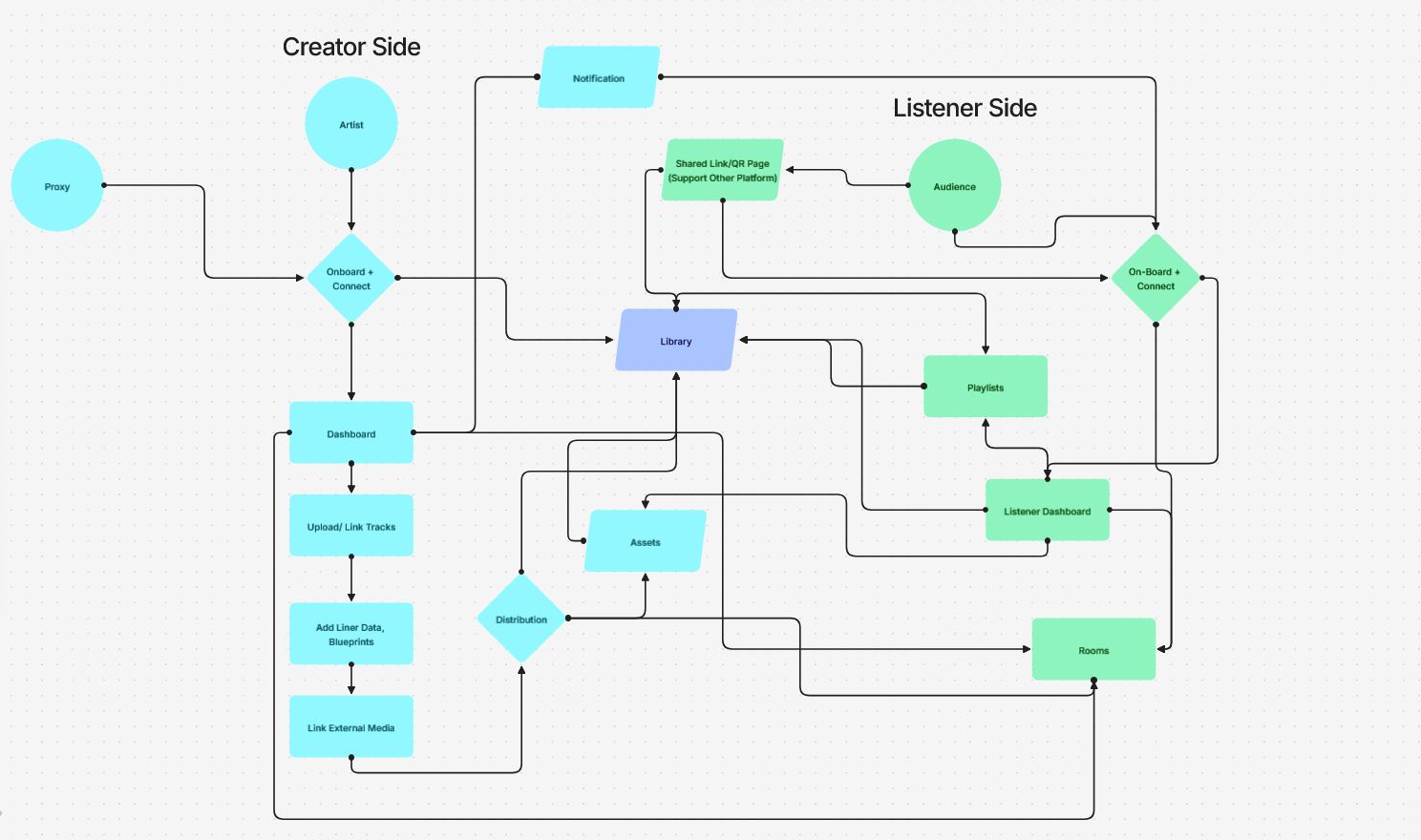
User flow:
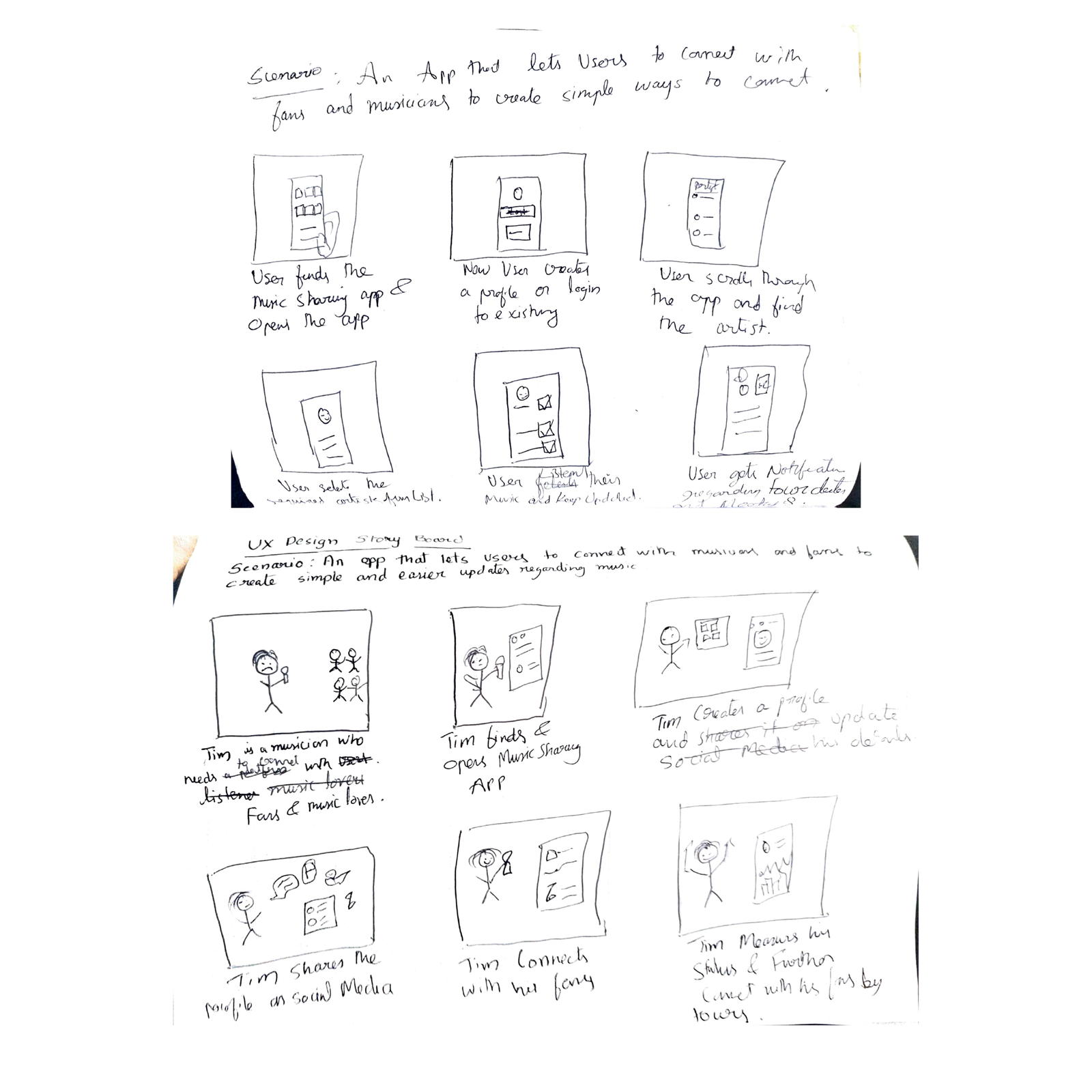
Early Thought Scribbles
First Wireframes:
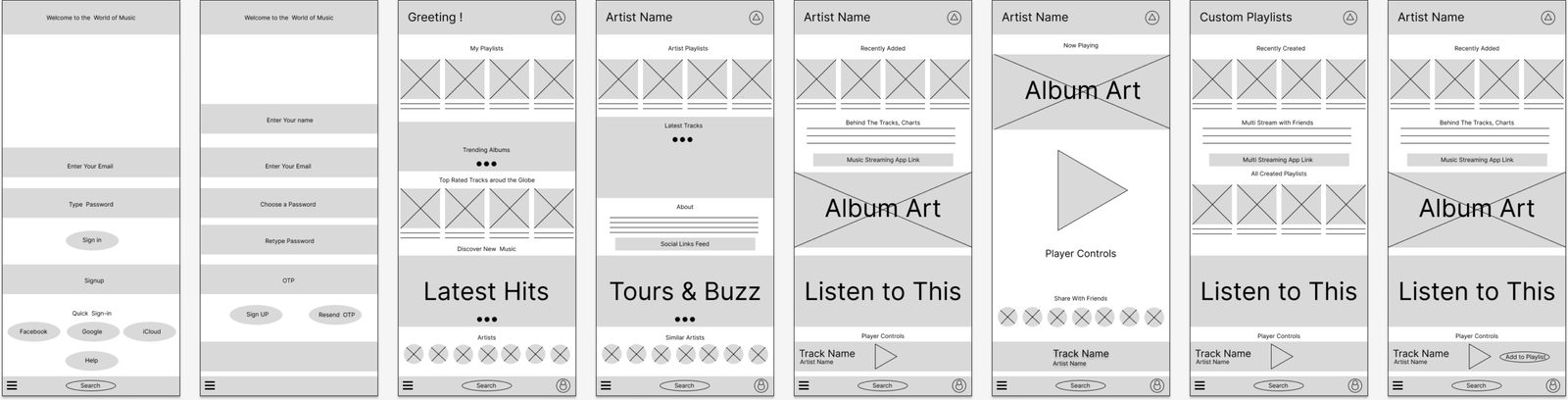
Early App Design: